

Runs on your hardware.
Learns from you.
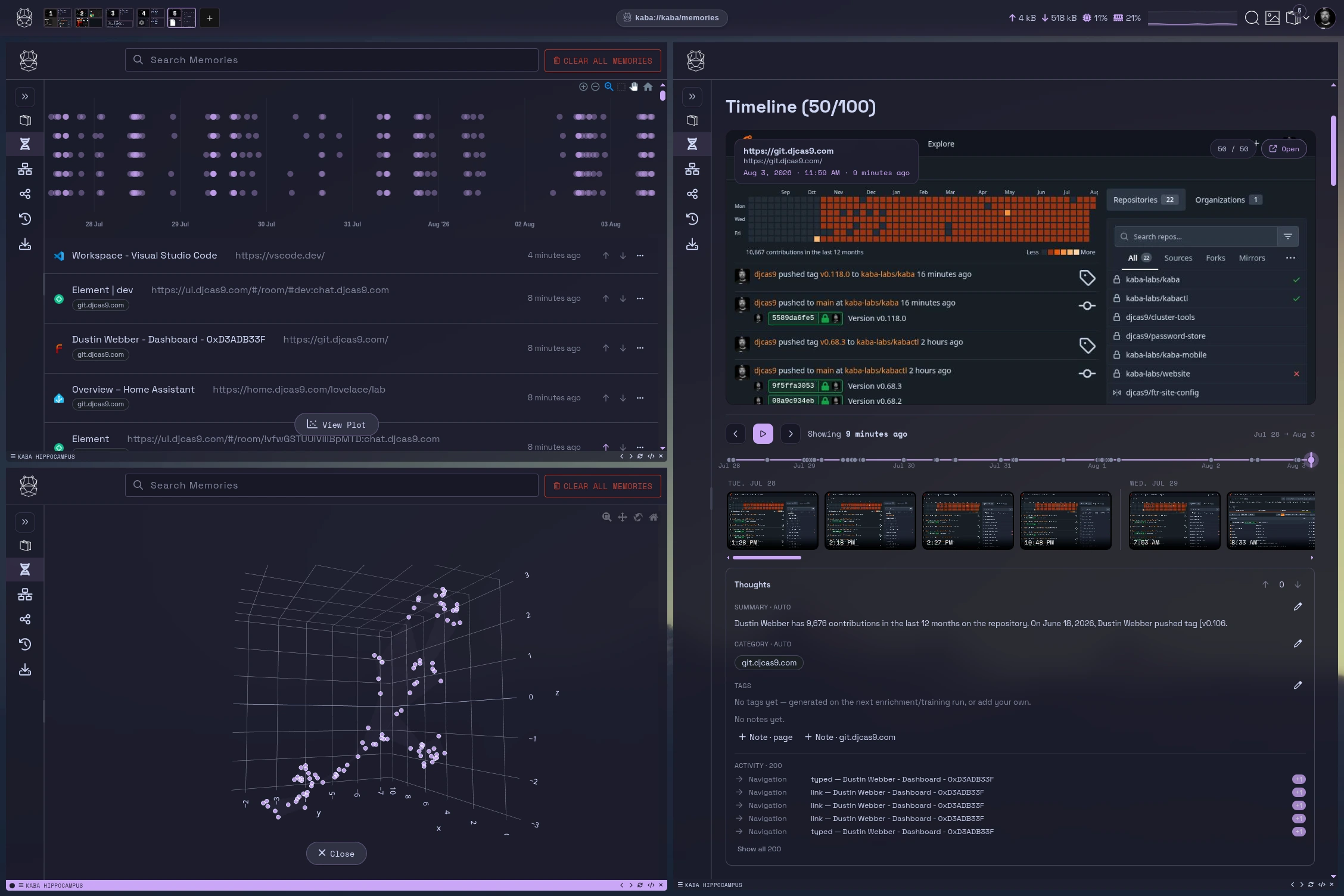
Keeps everything it learns.
You are the best training data there is. Right now you're training someone else's model. Kaba keeps it yours.
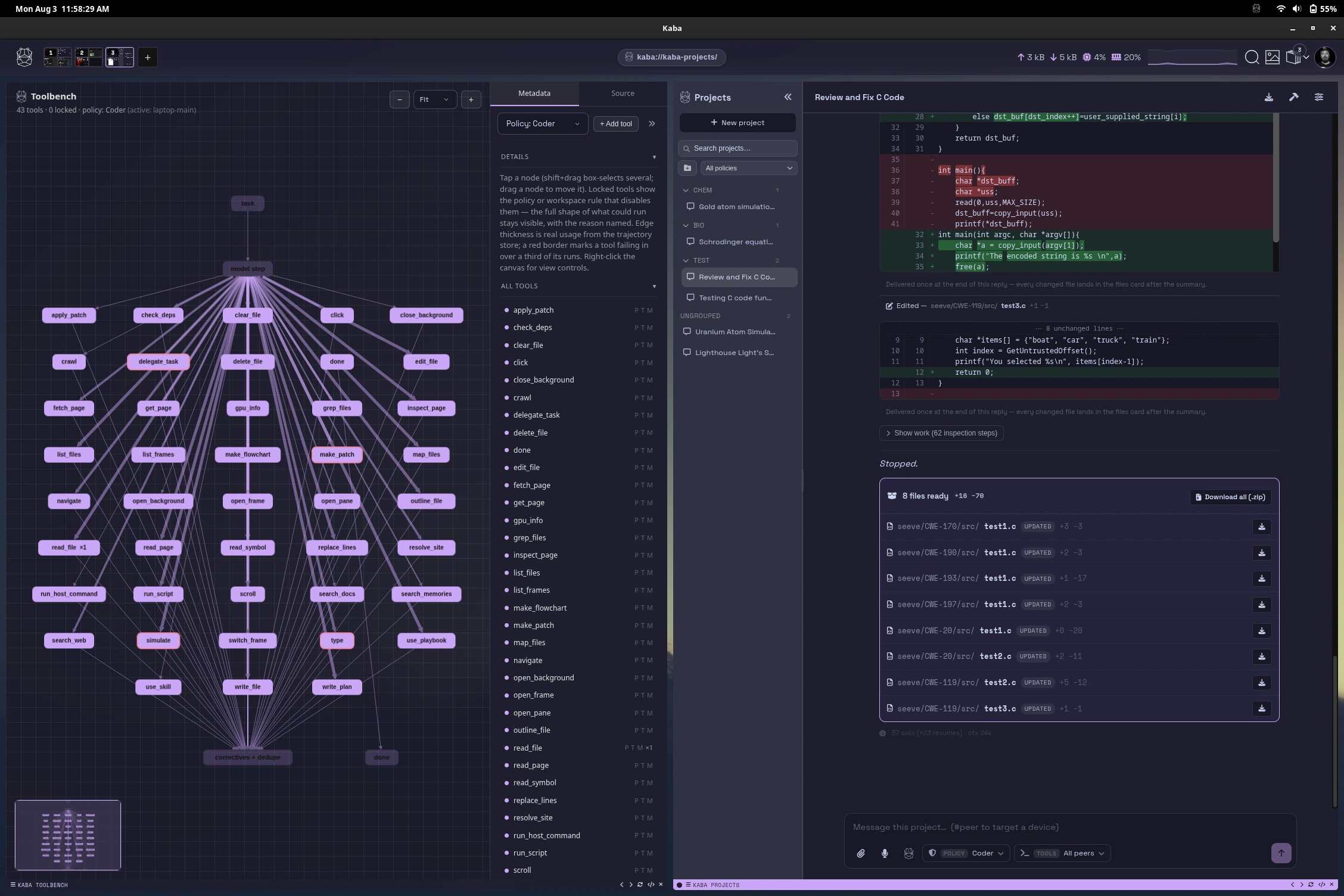
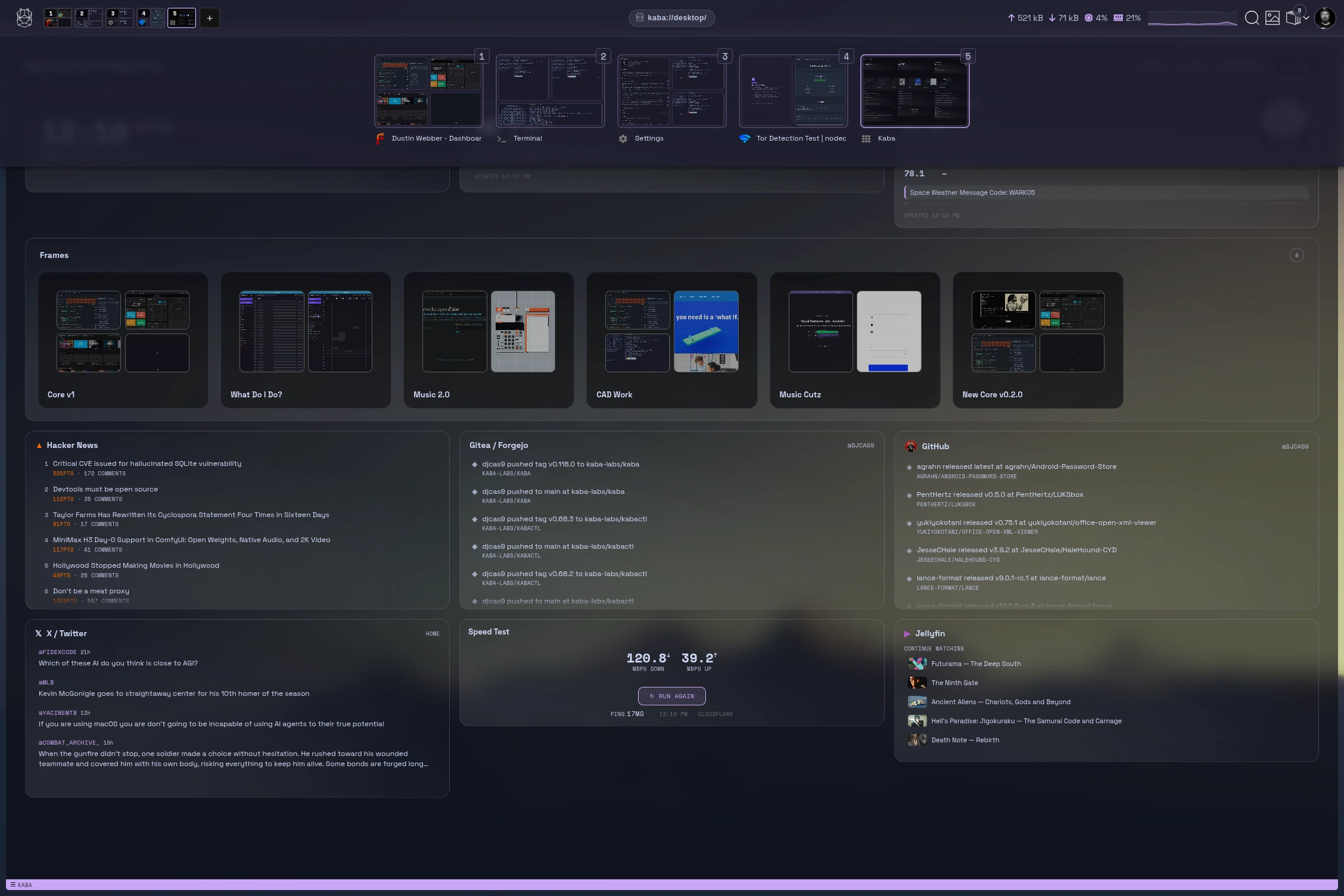
Browser, terminal, files, and models in a single harness on your devices. Kaba does the work itself, in the same windows you do. Policy checks every step before it runs.
Everything you see and do becomes private, encrypted memory, curated into clean datasets automatically.
Train expert models on your own context, on your own GPUs or a peer’s. Every version is evaluated before it ships.
A loop that runs continuously, stays on your hardware, and compounds with every task.
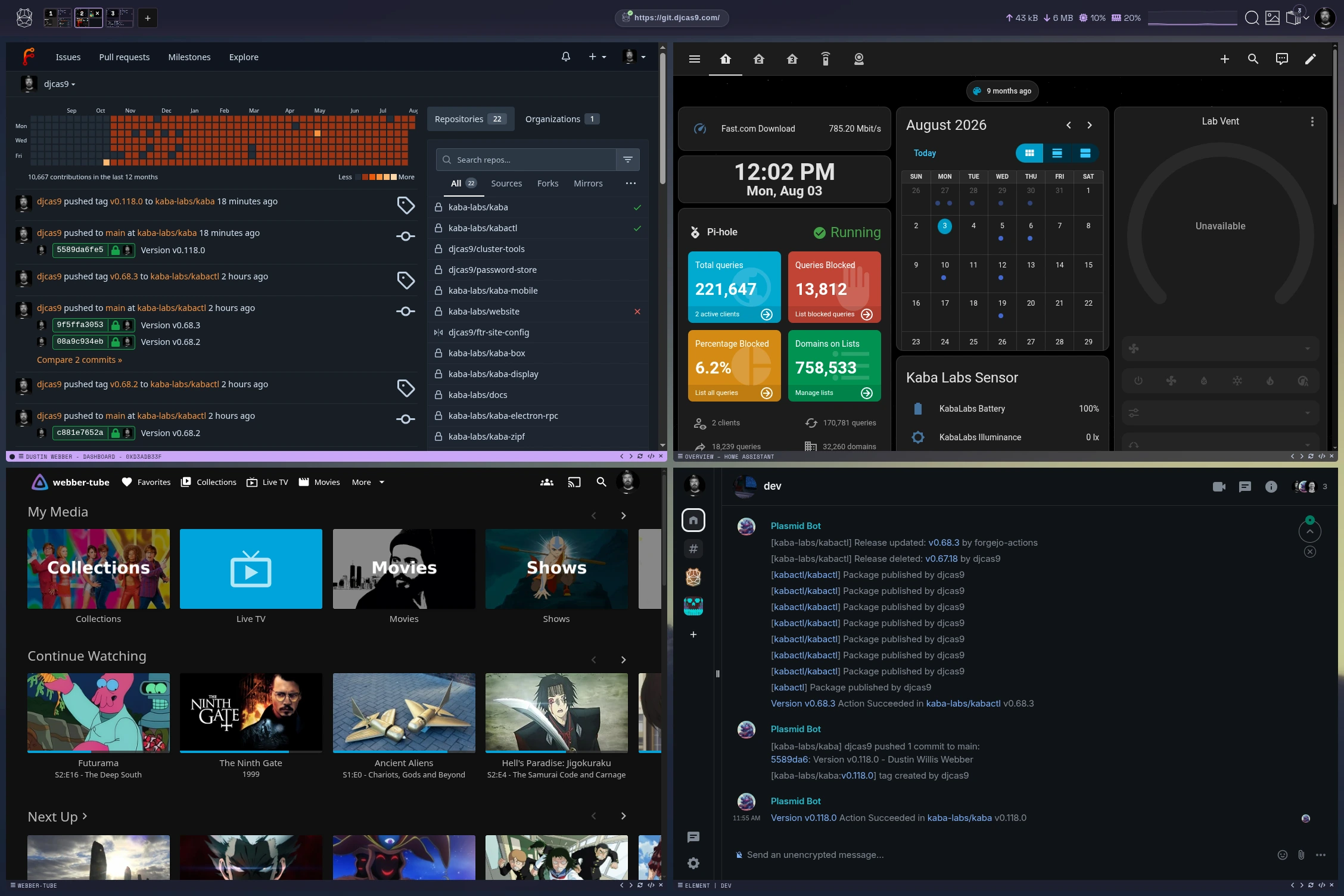
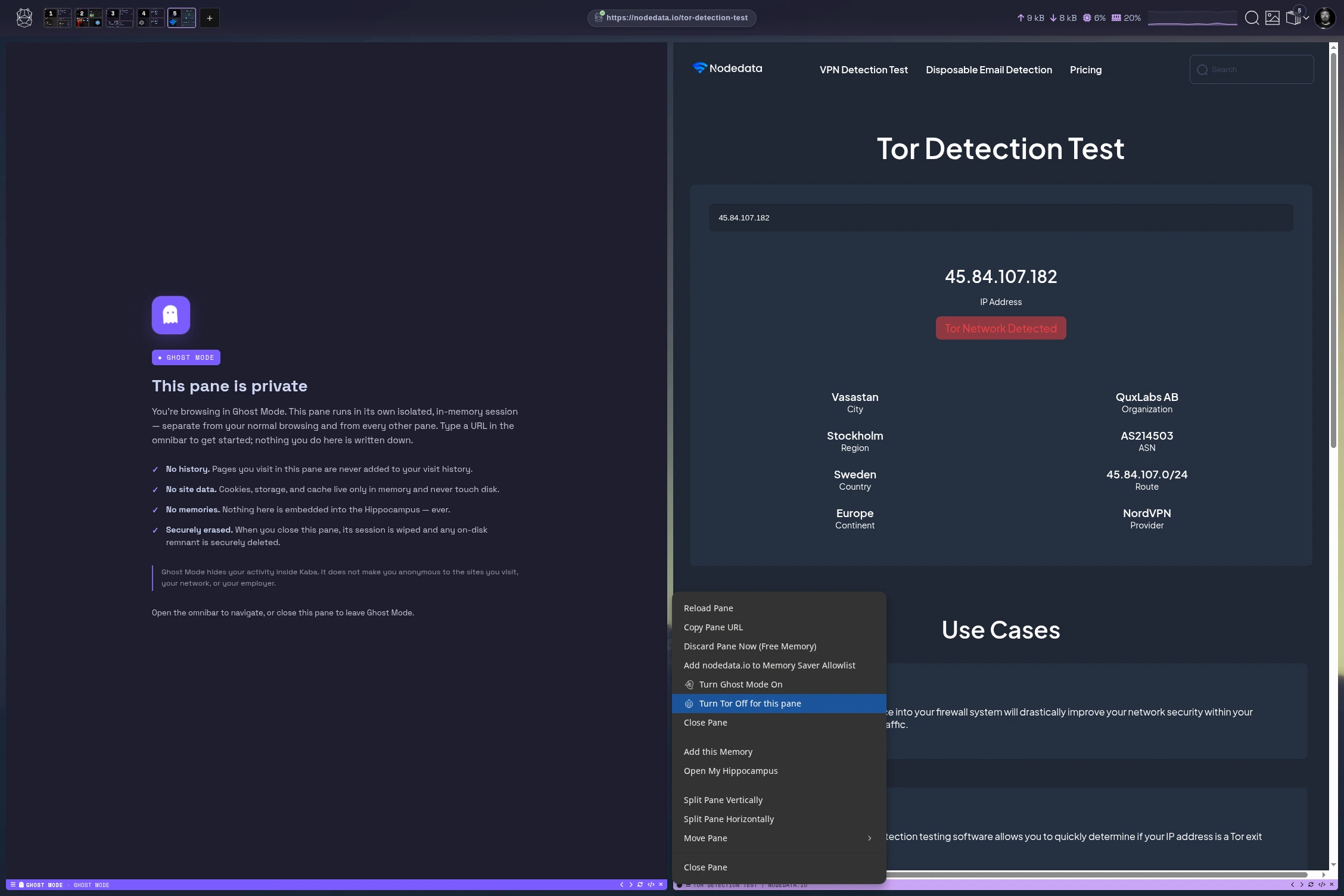
Models and memory are one part of Kaba, and every bit of it can be switched off. What stays is the best way you have ever used the internet: private, peer to peer, and built with features the big browsers will never ship.
Your laptop, desktop, and home lab become one private intelligence that learns from how you work. Build datasets from your own context, train LoRA experts on your own hardware, and own every one of them. Free and open source. Local and encrypted by default.
Using models is now the norm. With Kaba, build datasets, train with RL, and turn telemetry into fuel. Be your own lab.
Put intelligence to work on your own infrastructure, with your people, ontology, policies, and expertise in every loop. Accelerate adoption without turning speed into insider risk.
Every team is already using AI. The question is whether the company can see it, govern it, and keep what it learns.
Without a shared foundation, each new tool brings its own data copies, its own connectors, its own bill, and its own blind spots. Adding the next one never gets easier. A harness gives every model, workflow, and team the same ground to stand on, so the tenth deployment costs less than the first.
Government requirements shaped Kaba from the start. Data sovereignty, classification boundaries, accreditation, and full auditability were design inputs, so agencies can run Super Intelligence (SI) under their own authority.
Kaba runs 100% air-gapped. Models, data, and training stay on government hardware, with no outside connection required, and every run is governed by policy, audited, and accounted for.
Virtual desktop infrastructure (VDI) runs each employee's desktop as a virtual machine in a central data center and streams the screen to whatever device they use. It solved the last shift: data stayed in the data center, and IT could govern every desktop from one place, at the cost of speed. Intelligence that acts on your behalf can't work that way. They make thousands of small decisions, and every round trip to a VM or a remote API slows each one down. Local, instant AI needs a new way to run it: central control, distributed compute.
Kaba is not VDI. Nothing is virtualized and no screen is streamed. Work runs natively on each device, and fleet management gives IT the same controls VDI provided: enrollment, central policy, access rules, updates, audit, and remote wipe of keys and data.
An operating system decides what runs, what it can access, and how it talks to the outside world. Kaba does the same for AI across every device in the fleet, through the harness and its private network.
Every deployment runs through three loops: your people and ontology, your policies, and your expertise. They are built into the runtime, not sold as add-ons.
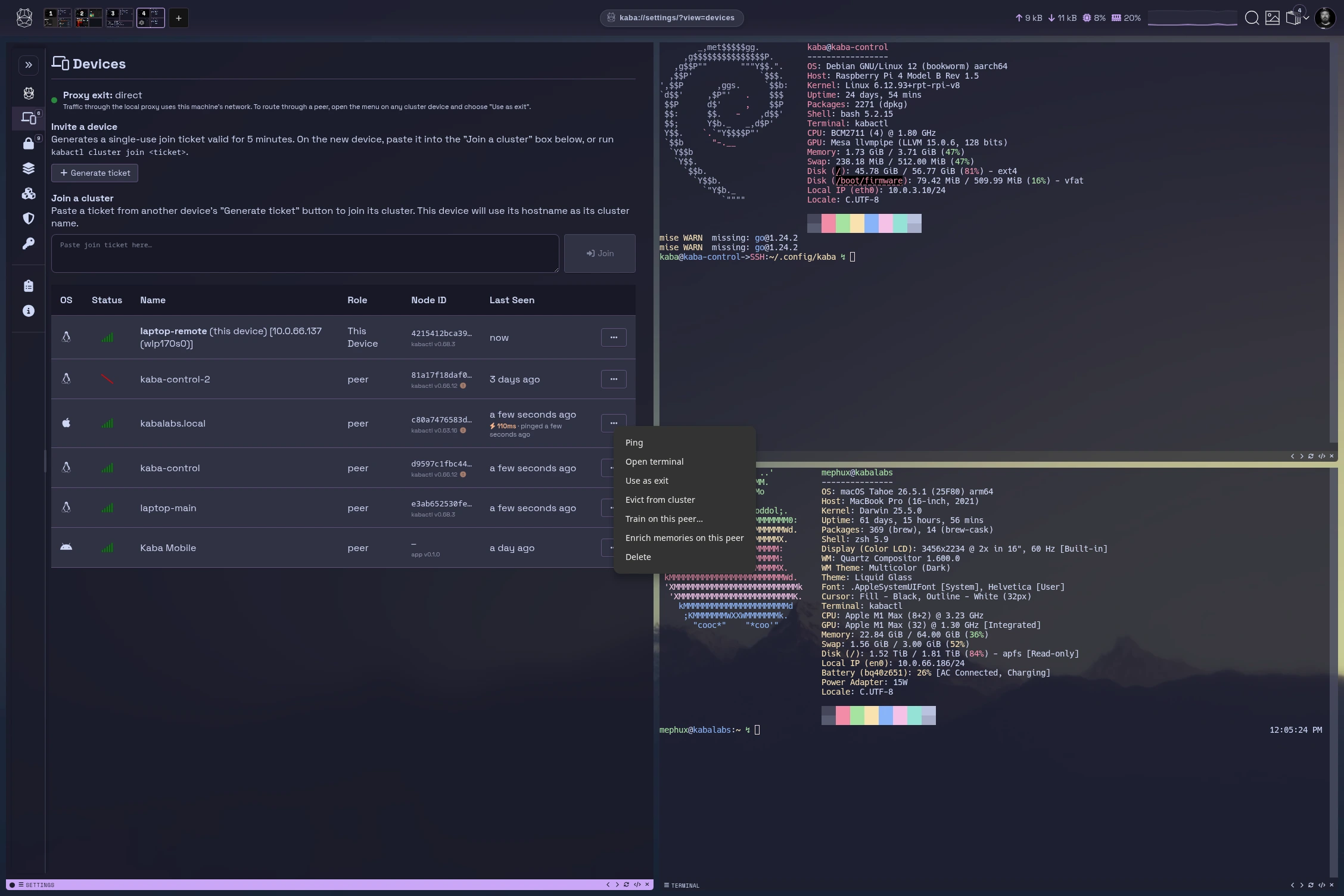
Every laptop, workstation, server, and edge device running Kaba is part of one fleet. Manage it, search it, and train across it, with every result feeding the company model.
Each team trains adapters on its own work. Kaba routes across them as a mixture of experts, so the company model improves every time someone does their job well.
The fastest way to adopt AI is to let everyone use it. When nobody understands where data goes, what automation can touch, or which models learn from it, that speed becomes the biggest risk inside your company. Kaba lets you accelerate with the risk visible and governed from the first deployment.
For most companies, AI spend is growing faster than anyone can track. Seats, API tokens, and cloud GPUs are billed by different vendors to different teams.
Cost and risk are the same problem. When you can't see who is using which model on what data, you can't secure it and you can't budget for it. Kaba puts use under control first, and cost control follows.
We've spent decades in enterprise security. We've also watched security teams become the reason new technology stalls.
We don't think that trade-off is necessary. You can move fast, understand your risk, and protect your data at the same time. Kaba is how we're proving it.
Our team has worked incident response at GE CIRT, done R&D at Mandiant, and built security companies that solved hard enterprise problems. Kaba is the latest of those, and not the last.